Denominations
Collecting the Panama Balboa: Silver Struck to American Standards
7 min read · Denari Coins editorial
Panama's 1/10 and 1/4 Balboa are silver dimes and quarters in everything but name — because a 1904 treaty said they had to be.
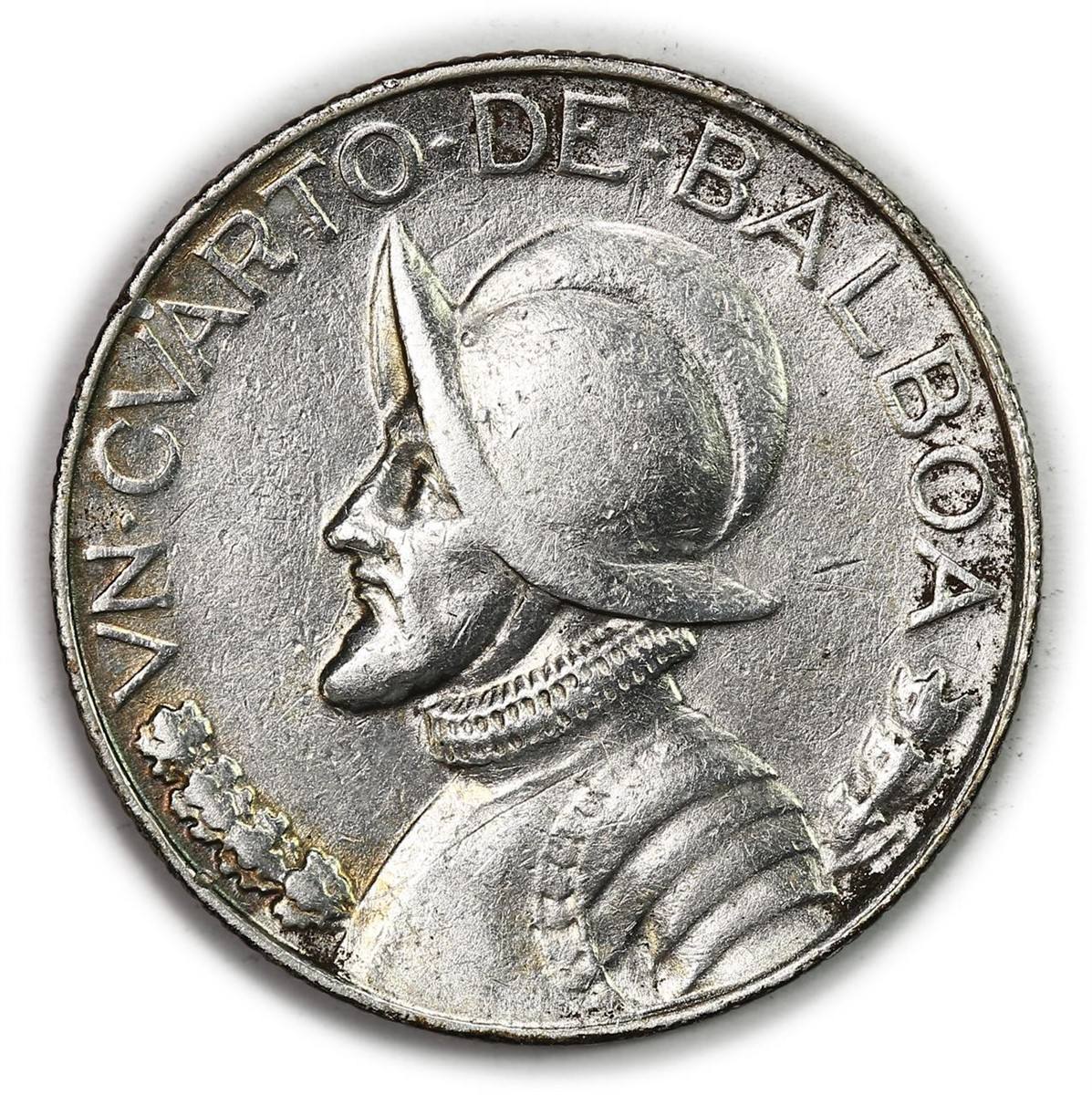
Panama is the rare country whose silver coinage is, by design, American silver coinage. The 1/10 Balboa in your hand weighs 2.50 grams of .900 fine silver because a United States dime weighs 2.50 grams of .900 fine silver. That is not a coincidence, and the reason why is the most interesting thing about the series.
A currency built on a treaty
Panama declared independence from Colombia in 1903. The following year, on 20 June 1904, its representatives signed a monetary agreement with the United States Secretary of War, William Howard Taft. The agreement fixed the new balboa at parity with the US dollar — one balboa, one dollar — and that peg has held ever since.
The practical consequence is the thing collectors notice first: Panama has no paper money of its own. US banknotes do the work of paper currency, and the balboa exists almost entirely as coin. The one attempt to change that lasted barely a month. In September 1941, President Arnulfo Arias established a central bank of issue and printed balboa notes; he was deposed in a coup in October, and the notes were withdrawn and mostly destroyed. Surviving examples are a famous rarity.
The currency takes its name from Vasco Núñez de Balboa, the Spanish conquistador who crossed the isthmus in 1513 and became the first European to see the Pacific from the Americas. His armoured, helmeted bust has carried the coinage for nearly a century.
The first coins, and the Panama Pill
The 1904 coinage came in centésimos — 2½, 5, 10, 25 and 50 — struck in silver. The 2½ centésimos is the one everybody remembers: at 1.25 grams it was so small that it earned the nicknames Panama pill and Panama pearl. It is a genuinely awkward coin to handle and a charming one to own.
1930: the Balboa denominations arrive
The series most collectors mean by "Panama silver" begins in 1930, when the 1/10, 1/4 and 1/2 Balboa were introduced, followed by the 1 Balboa in 1931. These were struck to United States standards — not approximately, but exactly:
- 1/10 Balboa — the US dime: 2.50 g, .900 fine, 17.91 mm
- 1/4 Balboa — the US quarter: 6.25 g, .900 fine, 24.25 mm
- 1/2 Balboa — the US half dollar: 12.50 g, .900 fine
- 1 Balboa — the US silver dollar: 26.73 g, .900 fine
The coins say so themselves. Look at the arms side of any of them and you will find LEY 0.900 on the left and the gram weight — GR. 2.50, GR. 6.25 — on the right, struck right into the field. Few series make it this easy to verify what you are holding.
Striking was done at the Philadelphia and San Francisco Mints and, for some issues, the Royal Mint in London. The designs stayed stable: the armoured bust of Balboa on one face, and on the other the Panamanian coat of arms beneath nine stars for the nine provinces of the day.
The 1953 Cincuentenario
In 1953 Panama marked fifty years of independence from Colombia. The commemorative issues are easy to identify and easy to overstate. They use the same designs, the same weights and the same .900 fineness as the regular coinage; the only difference is the word CINCUENTENARIO added below the Balboa bust.
They are attractive and historically neat, but with 3,300,000 struck of the 1/10 Balboa alone, they are not scarce. Treat a Cincuentenario as a nice type coin to have in the set, not as a key date.
Where the silver stops
Panama followed the United States out of silver. The .900 fine 1/10 and 1/4 Balboa run from 1930 to 1962; from 1966 the circulating coinage moved to copper-nickel clad, and by 1973 clad had taken over entirely. A .900 silver 1/10 Balboa dated 1966 does not exist.
That gives you a clean rule for buying: if the date is 1962 or earlier, the 1/10 and 1/4 Balboa are 90% silver. If it is later, assume clad until proven otherwise. The 1 Balboa is the exception that will catch you out — a .900 fine one-balboa piece was issued in 1966 even as the smaller denominations went clad.
What to look for when buying
Read the fineness off the coin. The LEY 0.900 / GR. legend is the fastest authentication check in world silver. If a coin claims to be a silver Balboa and lacks it, ask why.
Expect toning, and judge it on its merits. These coins circulated in a hot, humid, coastal country. Deep grey and gold cabinet tone is normal and often attractive. Green or crusty deposits are verdigris, which is active corrosion, and a different matter.
Grade the group, not the headline coin. Balboa silver is usually sold in date runs and mixed lots, and the condition inside a lot is rarely uniform. One well-worn or environmentally damaged coin among ten is common. Photographs of every coin, both faces, are the only way to know — and if a seller only shows you three of the ten, that is information too.
Do not overpay for common dates. Most 1/10 and 1/4 Balboas from the 1930s through the early 1960s are affordable, common coins whose value tracks silver content plus a modest collector premium. The series rewards patient set-building far more than it rewards chasing individual pieces.
Building the set
A date run of 1/10 Balboas is one of the friendliest world-silver projects there is: the denominations are small, the coins are cheap, the design never changes so wear is easy to compare across dates, and every coin states its own composition. Add the 1/4 Balboa for a bit of heft and the 1953 Cincuentenario for the history, and you have a set that tells the whole story of a currency built on a treaty.
If you want a running start, our Vintage Panama Silver Coin Lot covers eight 1/10 Balboas — 1930, 1931, 1932, 1933, 1934, 1947, 1953 Cincuentenario and 1961 — plus 1933 and 1961 1/4 Balboas, all .900 fine, with both faces of every coin photographed.
For a look at these coins in hand before you buy, see Panama Balboa Silver Coins on our video shelf.
Related reading
- Bullion vs Numismatic Coins — where a 90% silver world coin sits between the two
- Browse world silver in the shop
Watch
Advertisement
Browsing while you read? See certified coins in our vault →
Tools & references
Grading, supplies, and reference picks from trusted partners. We may earn a commission.
NGC
Submit your coins to NGC for certification
Grading from $23/coin
View at merchantPCGS
Grade & authenticate with PCGS
Tiered grading services
View at merchantWhitman
A Guide Book of United States Coins (the 'Red Book')
From $17.95
View at merchantDansco
Dansco coin albums for U.S. series sets
Albums & supplies
View at merchantAir-Tite
Air-Tite capsules & storage holders
Protect your coins
View at merchantAPMEX
Shop gold & silver bullion at APMEX
Live bullion pricing
View at merchant
New to coins & bullion?
Get our free starter series: the first-coin buyer's guide, how we authenticate every coin we sell, and $10 off your first order. A short email every couple of days — unsubscribe anytime.