Buying & Authenticity
How Much Is a Constantine Coin Worth?
6 min read · Denari Coins editorial
The honest dollar answer first, then the four things — wear, surfaces, silvering, mint marks — that decide whether a Constantine coin is a $20 keepsake or a four-figure rarity.
Most genuine coins of Constantine the Great are worth $20 to $75. These are the common bronze types — "soldiers and standards," VRBS ROMA, and Constantinopolis commemoratives — struck by the hundreds of millions in the fourth century. Attractive, well-preserved examples with sharp portraits bring $50–$150; exceptional certified pieces with original silvering can reach several hundred dollars. Rare types change the math entirely: Constantine's silver and especially his gold solidi run from the low thousands to $10,000 and beyond. Condition, type, and mint mark decide where your coin falls — here's how to tell.
Why most Constantine coins are affordable
Constantine I ruled for over thirty years (306–337) and ran mints from London to Antioch at full capacity, paying armies and building a new capital. His bronze coinage survives in enormous quantities — hoards of thousands still surface — so supply keeps prices friendly. That's not a defect; it's the reason a genuine coin of one of history's most consequential rulers is a realistic first purchase rather than a museum fantasy.
Values by type
Common bronze types — $20–$150:
- GLORIA EXERCITVS ("glory of the army") — two soldiers flanking standards; the most common type. Worn: $15–$30. Clear portrait and legends: $30–$75. Sharp with silvering: $75–$150.
- VRBS ROMA / CONSTANTINOPOLIS commemoratives — she-wolf with twins, or Victory on a prow. Hugely popular: $35–$85 in attractive grade.
- Campgate types — a fortified gateway under stars; architectural and collectible by mint: $30–$90.
- SOL INVICTO COMITI — Constantine with the sun god, from before his Christian turn: $30–$100.
Scarcer material, silver, and gold
Larger early folles with full silvering, scarce mint-and-workshop combinations, "eyes to heaven" portrait varieties, and high-grade certified examples occupy the $150–$1,000 band. Above that sit the precious metals: Constantine's silver (siliqua, miliarense) is genuinely scarce, and his gold solidus — the coin that anchored Mediterranean trade for seven centuries — starts around $2,500–$4,000 and climbs steeply with grade and portrait style.
The four things that move the price
Two coins of the same type can differ in price by a factor of ten. The gap comes down to four factors:
- Wear — can you read the emperor's face and part of the legend? "Worn smooth" to "sharp portrait" is often a 5× price difference.
- Surfaces — an even brown or green patina is prized; corrosion, pitting, or harsh cleaning cuts value sharply, sometimes below $10.
- Silvering — these bronzes left the mint with a thin silver wash; coins that retain it are dramatically more desirable.
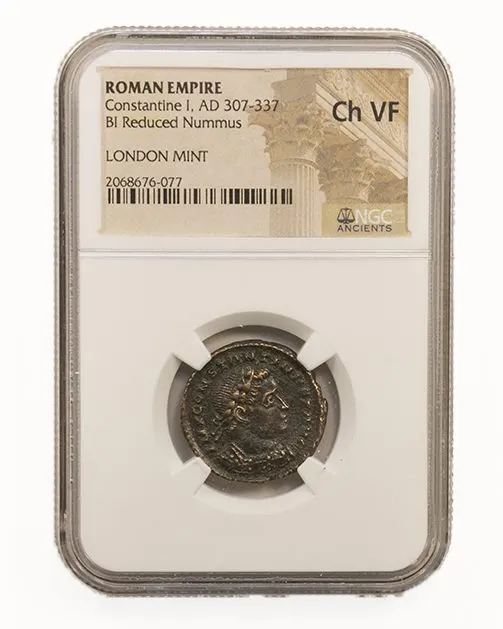
- Mint marks — the letters at the bottom of the reverse (CONS for Constantinople, PLON for London…). London-mint coins carry a strong premium with British collectors.
"I inherited one — is it valuable?"
The honest answer for most single coins found in a drawer: it's worth $20–$60, and it's still wonderful — you own the personal currency of the emperor who founded Constantinople and legalized Christianity. But don't guess. Check the diameter (most common types are 15–20 mm), match the reverse design against the types above, and read the mint mark. If the coin is silver or gold, larger than 24 mm, or unusually sharp, it deserves a professional opinion — a real appraisal costs you nothing at our appraisal desk.
How to know it's genuine
Constantine bronzes are cheap enough that faking them is barely worth a forger's time — fakes target rarer, pricier types. Still: weight and diameter should be in normal range, the coin should show striking (not casting) texture, and seams or pimply surfaces are red flags. For any coin that matters to you, certification settles it; our guide to how NGC grades ancient coins explains exactly what the label tells you.
The bottom line: $20–$75 for most bronzes, a few hundred for beautiful certified examples, thousands for silver and gold. If you're buying, that first band is one of the best entry points in all of collecting — see what's in the case. If you're selling, get a real appraisal before accepting a metal-value offer.
Advertisement
Browsing while you read? See certified coins in our vault →
Tools & references
Grading, supplies, and reference picks from trusted partners. We may earn a commission.
NGC
Submit your coins to NGC for certification
Grading from $23/coin
View at merchantPCGS
Grade & authenticate with PCGS
Tiered grading services
View at merchantWhitman
A Guide Book of United States Coins (the 'Red Book')
From $17.95
View at merchantDansco
Dansco coin albums for U.S. series sets
Albums & supplies
View at merchantAir-Tite
Air-Tite capsules & storage holders
Protect your coins
View at merchantAPMEX
Shop gold & silver bullion at APMEX
Live bullion pricing
View at merchant
New to coins & bullion?
Get our free starter series: the first-coin buyer's guide, how we authenticate every coin we sell, and $10 off your first order. A short email every couple of days — unsubscribe anytime.