Collecting
The Guardian’s Oath: A Guide to Numismatic Preservation and the Perils of Cleaning
5 min read · Denari Coins editorial
Do not clean your coins. While a coin may look unattractive to the untrained eye, its original mint luster and natural toning patterns are essential for establishing authenticity and condition.
The Guardian’s Oath: A Guide to Numismatic Preservation and the Perils of Cleaning
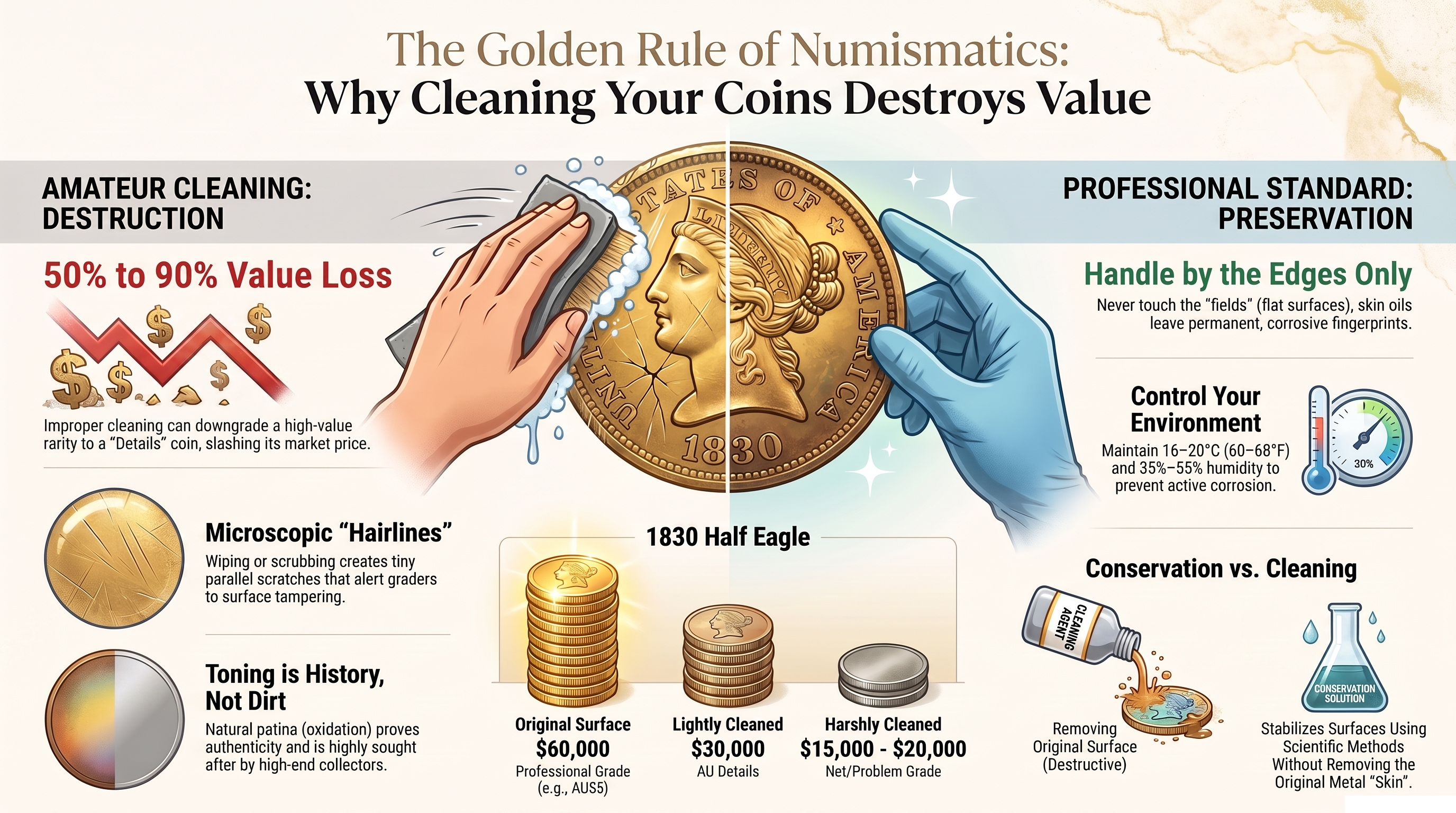
In the world of rare collectibles, there is a natural instinct to want things to look "shiny" and "new," but in numismatics, this instinct is the single most common cause of significant financial loss. For a professional numismatist, the dark or toned surface of an ancient coin is not "dirt" but a protective layer of history known as patina. Once this original surface is altered through amateur cleaning, the coin’s market value can plummet by 50% to 90%.
The Golden Rule: Do not clean your coins. While a coin may look unattractive to the untrained eye, its original mint luster and natural toning patterns are essential for establishing authenticity and condition.
Why Cleaning Harms Value
Amateur cleaning attempts often turn a desirable collectible into a discounted "details" coin. Professional grading services like NGC and PCGS use high-powered magnification to detect even subtle interventions:
- Hairlines: Microscopic, parallel scratches caused by rubbing a coin with a cloth, brush, or even a finger.
- Unnatural Brightness: A "washed-out" appearance that lacks the soft, original luster of an uncirculated piece.
- Dulled High Points: Aggressive cleaning removes minute amounts of metal from raised details, creating artificial wear.
Cleaning vs. Professional Conservation
It is vital to distinguish between destructive amateur cleaning and scientific conservation.
| Category | Amateur Cleaning | Professional Conservation |
|---|---|---|
| Primary Goal | Make a coin look newer or shinier | Stabilize the coin and remove harmful surface contaminants |
| Methods & Tools | Household products (toothpaste, baking soda, vinegar, lemon juice) | Non-invasive, controlled techniques by experts (e.g., NCS) |
| Surface Impact | Causes permanent surface scratching, etching, and metal loss | Preserves the original metal and stable historical patina |
| Market Result | Severe value loss (50%–90% reduction, "Details" grade) | Protects long-term eye appeal and structural stability |
Identifying True Threats: PVC and Bronze Disease
While natural toning is desirable, two specific active conditions require urgent intervention:
1. PVC "Green Slime"
- Cause: Historical coin holders made of Polyvinyl Chloride (PVC) contain plasticizers that leak over time and react with copper.
- Effect: Forms a sticky green residue across the surface.
- Risk: Left untreated, this acidic buildup permanently pits and etches the metal underlying the residue.
2. Bronze Disease (BD)
- Cause: Triggered by chloride contamination combined with ambient humidity.
- Effect: Manifests as bright green, powdery pustules on copper and bronze coins.
- Risk: Unlike stable patina, BD is a self-sustaining, cyclical electrochemical reaction that can completely consume a coin's core if not professionally stabilized.
Safe Intervention: The Solvent Polarity Ladder
If a coin is contaminated with organic residues like tape adhesive or grease, it must be stabilized without physical scrubbing. Conservation scientists use a Solvent Polarity Ladder, soaking the coin in a precise sequence of solvents that do not react with coinage metals:
Distilled Water: Removes loose surface soil.
Pure Technical Acetone: Breaks down organic polymers, tapes, and surface oils.
⚠️ Warning: Never use drug-store nail polish remover, as it contains perfumes and oils that leave reactive residues on the metal.
Pure Xylene: Solves highly stubborn, hydrophobic waxes.
Archival Storage: Protecting Your Legacy
Proper storage is the best defense against environmental degradation:
- Avoid Soft PVC: Use only archival-safe materials like Mylar (PET) flips or hard acrylic capsules.
- Control Humidity: Maintain a stable micro-climate with relative humidity (RH) below 35% for copper-bearing coins and below 50% for gold and silver. Use silica gel or montmorillonite clay desiccants to absorb excess moisture.
- Handle by the Edges: Skin oils, sweat, and saliva contain acids and enzymes that etch fingerprints or dark spots into metal over time. Always handle coins strictly by their edges, ideally wearing lint-free cotton or nitrile gloves.
Conclusion
A coin is more than just metal; it is a tangible piece of history. The strongest collectors are the most patient, understanding that a coin’s value lies in its original state. If you encounter a high-value coin with active corrosion or heavy buildup, resist the temptation to "fix" it yourself—seek a professional conservator to ensure your legacy remains intact for the next generation.
Advertisement
Browsing while you read? See certified coins in our vault →
Tools & references
Grading, supplies, and reference picks from trusted partners. We may earn a commission.
NGC
Submit your coins to NGC for certification
Grading from $23/coin
View at merchantPCGS
Grade & authenticate with PCGS
Tiered grading services
View at merchantWhitman
A Guide Book of United States Coins (the 'Red Book')
From $17.95
View at merchantDansco
Dansco coin albums for U.S. series sets
Albums & supplies
View at merchantAir-Tite
Air-Tite capsules & storage holders
Protect your coins
View at merchantAPMEX
Shop gold & silver bullion at APMEX
Live bullion pricing
View at merchant
New to coins & bullion?
Get our free starter series: the first-coin buyer's guide, how we authenticate every coin we sell, and $10 off your first order. A short email every couple of days — unsubscribe anytime.